


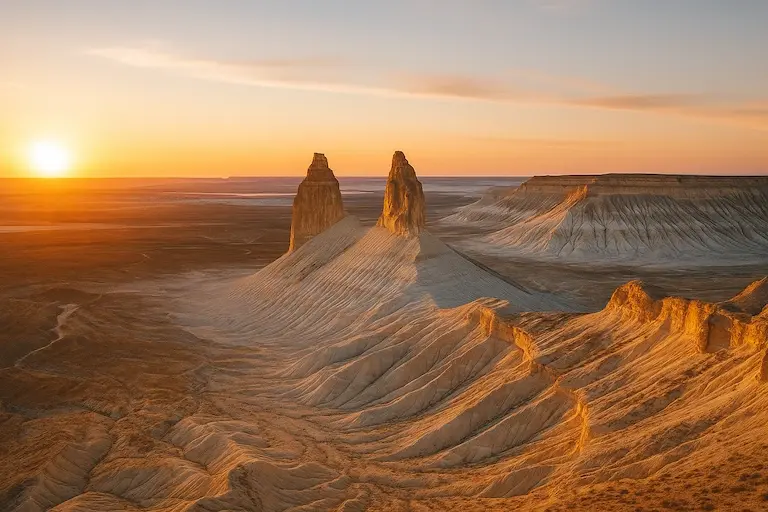
Wind-carved cliffs bleached bone-white, chess-piece buttes rising from a fossil sea, and sanctuaries hewn straight into the rock—Mangystau (Mangistau) on Kazakhstan’s Caspian edge feels like a planet of its own. Centered on the port city of Aktau, the region blends stark desert beauty with centuries of spiritual tradition. In a few days you can trace caravan trails across the Ustyurt Plateau, stand beneath the serrated walls of Bozzhira, wander among the mysterious stone spheres of Torish, and pay respects at the underground mosques of Beket-Ata and Shakpak-Ata. This guide mixes storytelling with the essentials you need to plan a safe and soulful trip.
Why Mangystau captivates
Geologically, Mangystau is a puzzle of uplifted seabeds and eroded chalk, sculpted by wind and time. Culturally, it is a crossroads: Sufi shrines, caravan routes, cemetery domes, and nomadic memory etched into the steppe. The result is a rare pairing—otherworldly landscapes coupled with living pilgrimage. Adventurers come for off-road panoramas and night skies; believers come to honor saints whose names echo across Central Asia.
Must-see places (with traveler notes)
1) Bozzhira Tract (Bozzhira Canyon)
The poster child of Mangystau: jagged limestone towers and amphitheaters glowing ivory at sunrise and peach at dusk. Viewpoints range from high rim overlooks to valley floors where buttes loom like cathedral spires. Trails are informal; stay back from cornices and heed wind gusts. Photographers should plan two light windows—dawn and late afternoon.
Tip: Access is via graded tracks and rough spurs—4×4 required. Carry extra water and watch for crumbly rock near edges.
2) Sherkala (“The Lion’s Castle”)
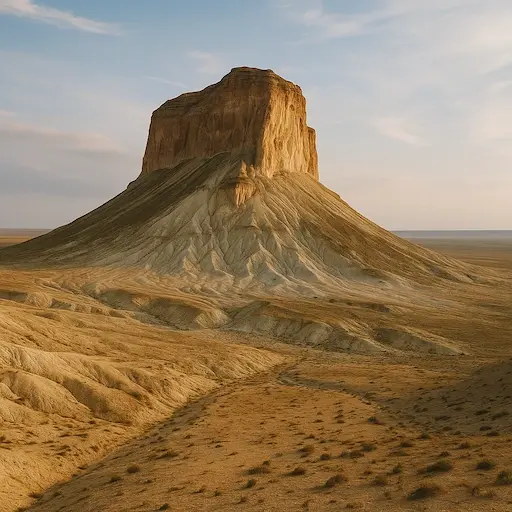
A solitary mesa rising from the steppe, Sherkala changes personality with the sun—lion-like at some angles, fortress-like at others. Short hikes loop around its base past caves and weathered folds. It’s a perfect pairing with Bozzhira on a long day out from Aktau.
3) Torish (Valley of Balls)
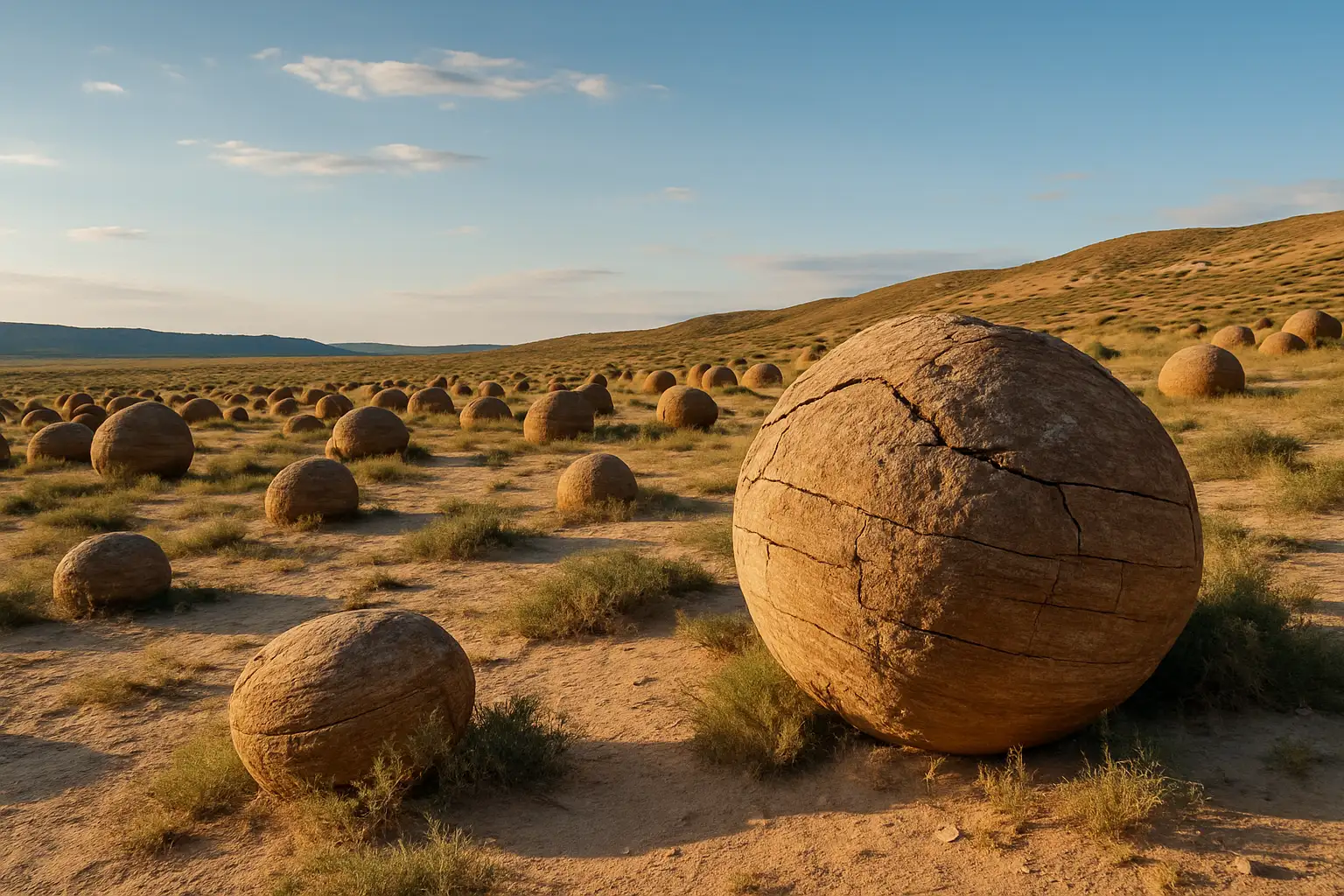
A field of spherical concretions—stone “planets” scattered across the desert. The effect is whimsical and eerie, particularly under high clouds or moonlight. Handle with care and avoid climbing fragile formations.
4) Airakty–Shomanay (Valley of Castles)
Buttressed ridges and castle-shaped turrets form a natural skyline, with gullies that invite short scrambles. The scale is cinematic; bring a wide lens. In spring, pockets of desert flowers soften the chalk with splashes of color.
5) Beket-Ata Underground Mosque (Oglandy)
One of Kazakhstan’s most revered shrines, Beket-Ata is carved into the cliff—a complex of chambers used for prayer, reflection, and rest. Pilgrims often arrive in groups; the atmosphere is humble and powerful. Dress modestly, speak softly, and follow any guidance from caretakers.
Etiquette: Women should cover hair; everyone should wear clothing that covers shoulders and knees. Photography inside prayer spaces may be restricted—ask first.
6) Shakpak-Ata Underground Mosque
Older and architecturally distinct, Shakpak-Ata is honeycombed with chambers and carved symbols. It’s quieter than Beket-Ata and ideal for a contemplative hour. Outside, weathered cemetery markers tell stories in stone.
7) Tuzbair Salt Flats & Ustyurt Edge
Where the plateau fractures into dazzling saline pans, mirror-like surfaces reflect cliffs and sky after rain. In dry spells, the polygon-cracked crust crunches underfoot. Check recent conditions; avoid driving onto damp salt.
8) Otpet (Otpet/Opet) Mud Volcano Area
Cones and vents bubble up cool mud, leaving rippled gray flows. Activity is sporadic; even when still, the forms are sculptural. Keep distance from fresh vents and don’t leave footprints in fragile mud rims.
9) Caspian Coast (Aktau & beyond)
Balance the desert with water: Aktau’s beaches and sea cliffs offer golden sunsets, seafood dinners, and a chance to rinse off the dust. In summer, an evening swim erases a day’s heat; in shoulder seasons, the promenade is lively and breezy.
How to see it: routes from Aktau
Base: Most travelers fly into Aktau (SCO) and use it as a staging point. Overnight trips open more scenery with safer pacing.
Classic 1–2 day arcs
- Bozzhira + Sherkala (long day or 1 night): Dawn departure, Sherkala circuit, Bozzhira golden hour, camp or return late.
- Torish + Airakty (day): Start with the spheres, then to “castles” for afternoon light.
- Beket-Ata + Shakpak-Ata (day or with camp): A spiritual circuit; build in time for quiet visits.
- Tuzbair + Ustyurt edge (day): Watch for wind and salt conditions, bring eye protection.
3-day sampler (balanced):
Day 1: Aktau → Sherkala → Bozzhira sunset (camp or guest yurt).
Day 2: Sunrise at Bozzhira → Torish → Airakty → back to Aktau.
Day 3: Beket-Ata & Shakpak-Ata → evening on the Caspian.
When to go (and when not)
- Best: April–June and September–October. Warm days, cool nights, clearer horizons.
- Summer (July–August): Extreme heat often > +40 °C; travel only with robust A/C, extra water, and early/late hours.
- Winter: Cold, windy, and short daylight; roads can be slick after snow or rain, and windchill bites on exposed rims.
Safety, access & sustainability
- 4×4 and guidance: Tracks can vanish into wadis, and chalk slopes turn treacherous when wet. Hire a local driver/guide—you’ll gain safety, context, and time efficiency.
- Fuel & range: Top up in Aktau; outside towns, fuel is sparse. Carry a second spare tire, compressor, and recovery strap.
- Navigation: Download offline maps; cell service is patchy. A satellite communicator is a smart extra for remote nights.
- Water & shade: Minimum 3–4 liters per person per day (more in summer). A tarp or wide-brim hat beats the noon sun.
- Wind & edges: Gusts can be fierce on rims—keep cameras and hats leashed, stay back from overhangs, and watch kids closely.
- Cultural respect: Shrines are active; dress modestly, remove shoes where requested, and never leave litter. Avoid drone use near sacred sites unless explicitly permitted.
- Leave No Trace: Cryptobiotic crusts and salt flats are fragile; drive only on established tracks and pack out all waste.
What to pack
- Breathable long sleeves and pants; insulating layer for nights
- Sun hat, sunglasses, high-SPF sunscreen, lip balm
- Sturdy hiking shoes (chalk dust is slick)
- 3–4 L water/day + electrolytes; snacks and a simple lunch
- Headlamp, power bank, car charger
- First-aid kit, blister care, personal meds
- Scarf/head covering for shrine visits
- Camera with wide and moderate telephoto lenses; lens cloths (dust!)
Food, lodging & prayer
- Aktau has a full spread of hotels, cafés, and halal dining.
- In the desert you’ll find only occasional guest yurts or simple homestays—book via local operators.
- Pack lunches and hot drinks for remote days; evenings back in Aktau are perfect for seafood on the promenade.
- Prayer spaces are available at shrines; ask caretakers for directions and follow local custom.
Story moments to chase
- The first blush of sunrise on Bozzhira, when white cliffs turn rose.
- A silent circle among the stone spheres of Torish, listening to wind.
- A whispered prayer in the cool chambers of Beket-Ata.
- Milky Way arcs over the Ustyurt edge—if you camp, the stars are a cathedral.
Responsible photography
Telephoto lenses compress the scale of buttes and towers; a polarizer helps tame glare on chalk faces. Avoid climbing delicate formations, keep people small in frame for scale, and never stage shots that risk a fall. At shrines, ask before photographing people and skip flash indoors.
The takeaway
Mangystau rewards those who prepare well and travel lightly—with respect for sacred places and patience for long horizons. Come for the “Martian” panoramas; stay for the quiet human stories carved into stone. Between the Caspian’s blue line and the Ustyurt’s pale cliffs, you’ll find one of Central Asia’s most distinctive journeys—half expedition, half pilgrimage.
